The Infrastructure Squeeze: Navigating Hardware Constraints
Overview
There's a not-so-quiet crisis unfolding in organizations across the country. It's making headlines, driving water cooler conversations, and even finding its way to the dinner table. The cost of hardware is climbing. Lead times are stretching. And the quotes your team received last month? They may already be obsolete.
Welcome to the new reality of infrastructure procurement, where budgets are stressed, timelines are broken, and standing still might be the riskiest move of all.
TL;DR
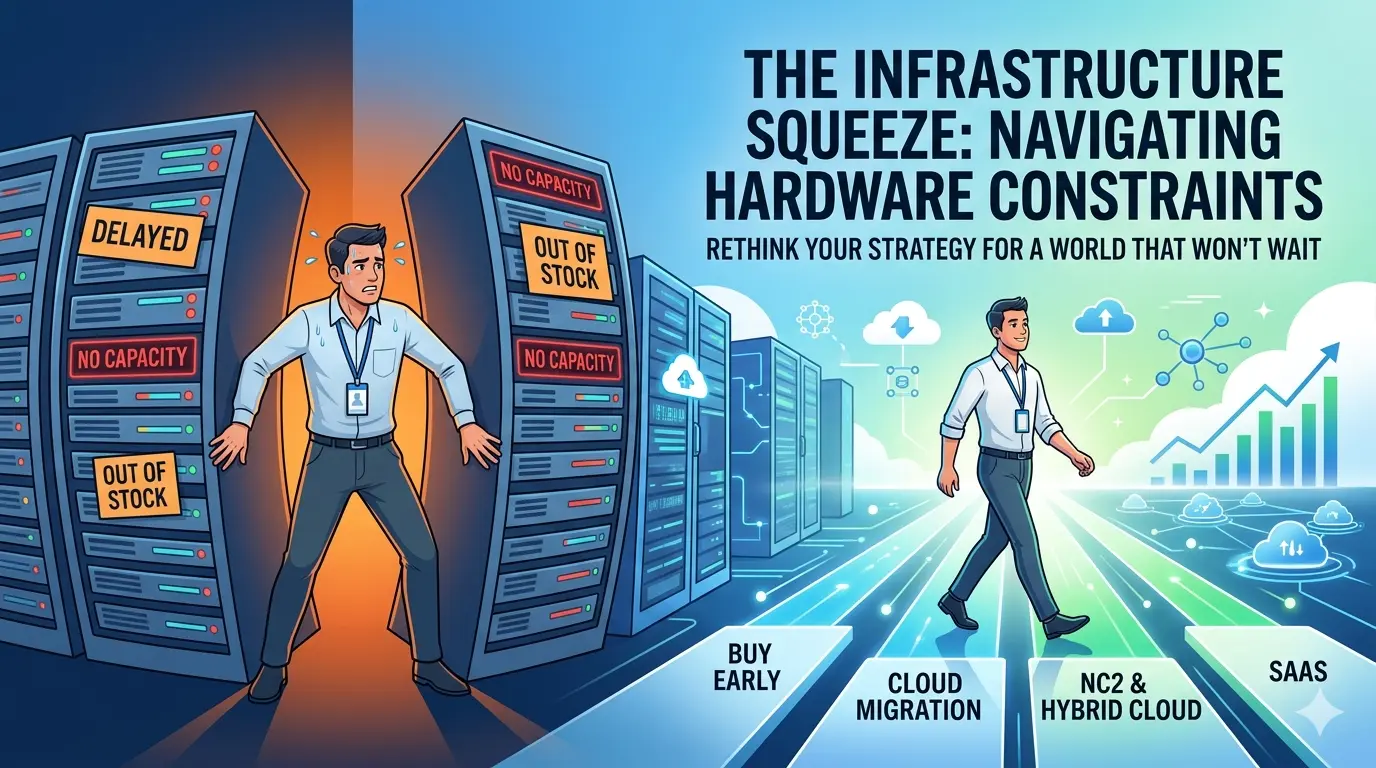
This is a long post, so here's the short version. Hardware procurement is in a difficult place right now, driven by tariffs, memory shortages, and AI-driven demand. Organizations are responding in several ways, and most will use a combination of these approaches:
- Get ahead of the curve by purchasing early to lock in pricing and secure your place in the queue, even if it means pulling budget forward.
- Extend and hold by renewing warranties and support contracts to buy time while you build a longer-term plan.
- Migrate to the hyperscalers by moving workloads to AWS, Azure, or Google Cloud, though this requires careful planning around networking, costs, and skills.
- Evaluate SaaS alternatives to eliminate infrastructure management entirely for workloads where a vendor-hosted solution makes sense.
- Leverage service providers who offer hosted infrastructure, DRaaS, and migration services, many of them built on the same Nutanix or VMware platforms you already run.
- Use seamless workload mobility solutions like Nutanix Cloud Clusters (NC2) or VMware cloud solutions (AVS, VMware Cloud on AWS, GCVE) to extend your existing environment into the cloud with IP portability and operational consistency, whether as a short-term bridge or a long-term strategy.
Each of these has trade-offs. Read on for the details.
The Problem Nobody Planned For
Enterprise IT has weathered supply chain disruptions before. The pandemic-era chip shortages taught hard lessons about the fragility of global manufacturing. But what's happening now feels different, and in many ways, more complex.
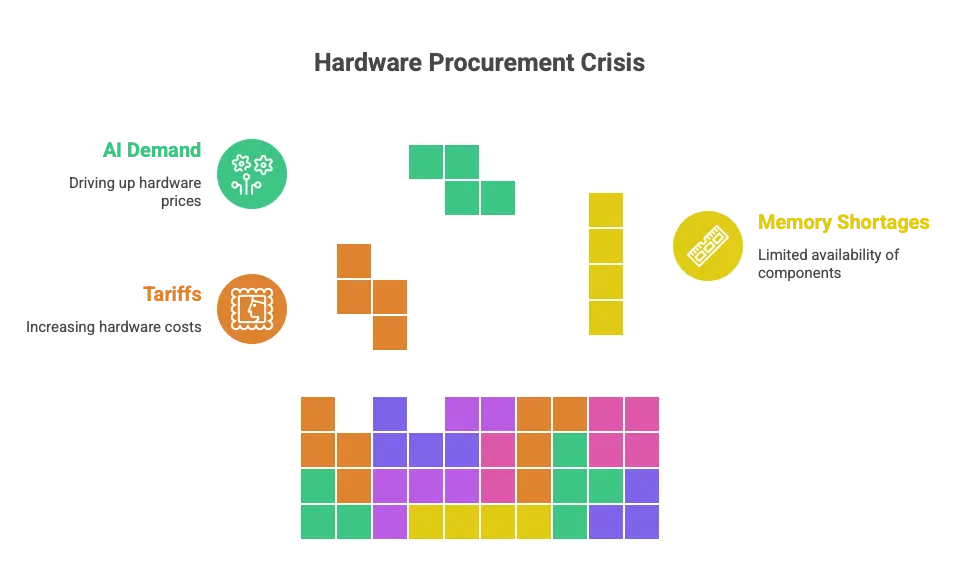
Today's constraints aren't driven by a single event. They're the result of converging forces: surging demand for AI-capable infrastructure consuming enormous amounts of memory and compute, tariff policies reshaping the cost structure of servers, networking gear, and storage, and a memory market that has tightened dramatically. The result is a procurement environment where lead times for enterprise servers can stretch six months or longer, and where a hardware quote is only as good as the week it was issued.
For many organizations, this isn't an abstract problem. It's a budget problem. When the price of a server refresh jumps double digits between the time you submit the capital request and the time procurement issues the PO, something has to give. Projects get pushed. Upgrades get deferred. And the gap between what the business needs and what IT can deliver quietly grows wider.
This isn't limited to compute. Storage arrays, network switches, even the cabling and optics that connect it all. Every layer of the infrastructure stack is feeling the pressure. Organizations that planned their refresh cycles around predictable pricing and reasonable lead times are finding that neither assumption holds anymore.
So What Are Your Options?
When the ground shifts beneath you, the instinct is to freeze. Wait for things to normalize, hope the next quarter brings relief. But inaction has its own cost. Aging infrastructure doesn't just underperform; it becomes a liability. Extended warranties and support contracts can buy time, but they don't buy capability. And every month you delay is a month your competitors might not.
That said, there's no single right answer. The best path forward depends on your organization's risk tolerance, financial flexibility, and strategic priorities. Here are the plays we're seeing smart IT leaders make right now.
Get ahead of the curve. Some organizations are choosing to buy early, even outside their normal budget cycle, to lock in pricing and secure a place in the queue. It's not comfortable, and it requires executive buy-in to pull budget forward. But when lead times are measured in quarters rather than weeks, getting your order in now for hardware you'll need in six months can be the difference between a project that ships on time and one that doesn't. Think of it less as premature spending and more as hedging against uncertainty.
Extend and hold. Not every organization has the budget flexibility to buy early or the cloud readiness to migrate quickly. For these teams, the pragmatic play is to extend warranties, renew support contracts, and squeeze more life out of existing infrastructure. It's not glamorous, and it doesn't solve the underlying problem. But it keeps the lights on while you build a longer-term plan. The key here is being intentional about it. Extending support as a strategy, not just defaulting to it because you ran out of options.
Migrating to the Hyperscalers
For organizations already exploring cloud strategies, the current environment is accelerating timelines. Why wait six months for hardware when you can migrate workloads to AWS, Azure, or Google Cloud? Migrations that were on a two-year roadmap are being compressed into months, not because the technology strategy changed, but because the procurement reality did.
Benefits:
- Eliminates hardware procurement from the equation entirely for migrated workloads, removing your organization from the cycle of lead times, expiring quotes, and budget surprises.
- Provides access to the full depth of cloud-native services, from managed databases and serverless compute to AI and analytics tooling that would be difficult or expensive to replicate on-premises.
- Shifts spending from a capital expenditure model to an operational one, giving finance teams more predictability and flexibility in how they plan and allocate budget.
- Enables organizations with distributed teams or global footprints to deploy capacity in regions close to their users without building or leasing data center space.
Risks:
- Requires tight planning and careful design. On-premises IP schemes, firewall rules, DNS configurations, and application dependencies all need to be accounted for. Get the design wrong and you're looking at extended downtime, broken application connectivity, or performance issues that are painful to troubleshoot after the fact.
- Operational costs can surprise teams that aren't prepared for the consumption-based model. Workloads that run predictably on-premises can generate unexpectedly high cloud bills without proper governance, right-sizing, and cost management practices in place.
- Skill gaps are real. Your team may be experts in on-premises infrastructure, but managing cloud-native environments requires different tooling, different monitoring, and a different operational mindset.
- Repatriation is complex. If you ever need to bring workloads back on-premises, the return trip can be just as difficult without the right tooling and planning in place.
This is a viable and increasingly popular option, but it's not one you want to rush into without the right expertise and a solid migration framework.
Evaluating SaaS Alternatives
While much of this conversation centers on where to run your infrastructure, it's worth asking a different question entirely: do you need to run it at all? For certain workloads, the current procurement environment is a good catalyst to evaluate whether a SaaS solution can replace what you're hosting on-premises or in your own cloud environment.
Benefits:
- Eliminates infrastructure management entirely for the workloads you move. No hardware to procure, no VMs to patch, no capacity to plan. The vendor handles all of it.
- Accelerates time to value. SaaS solutions are typically ready to consume immediately, which can be a major advantage when hardware delays are pushing project timelines out by months.
- Shifts the operational burden to the vendor, freeing your team to focus on higher-value work rather than maintaining commodity services like email, file storage, or collaboration platforms.
- Provides built-in redundancy, updates, and security patching without requiring your team to manage those processes.
Risks:
- Not every workload is a candidate. Applications with heavy customization, strict data residency requirements, or deep integration into on-premises systems may not have a viable SaaS equivalent.
- Long-term costs can exceed what you'd pay to self-host, especially at scale. SaaS pricing models based on per-user or per-seat licensing can grow quickly as your organization expands.
- Data portability and vendor lock-in are real concerns. Moving data into a SaaS platform is usually straightforward, but getting it back out (or migrating to a different provider) can be difficult and expensive.
- You lose a degree of control over uptime, feature roadmaps, and how your data is stored and processed. For regulated industries, this can introduce compliance considerations that need careful evaluation.
The key is being selective. Not every application needs to be self-hosted, and the infrastructure squeeze is a good reason to audit your environment and identify workloads where SaaS makes more sense than continuing to manage the underlying infrastructure yourself.
Leveraging Service Providers
Not every organization wants to manage a direct relationship with a hyperscaler, and not every workload justifies the complexity of a full cloud migration. This is where service providers can play a valuable role. Much like the hyperscalers, many service providers offer solutions for workload migrations and Disaster Recovery as a Service (DRaaS), giving organizations flexibility without requiring them to build and manage everything in-house.
What makes service providers particularly worth evaluating in the current environment is that many of them have built their platforms on the same ecosystems you're already running. Whether your environment is based on Nutanix or VMware, there are service providers offering hosted infrastructure, DR, and migration services on those same platforms. That means you can extend into a provider's environment without re-platforming or retraining your team, with the added layer of managed services and support.
Benefits:
- Provides an alternative path to offload workloads or establish DR without managing hyperscaler infrastructure directly. For organizations with smaller IT teams or limited cloud expertise, this can significantly reduce operational burden.
- Many providers offer solutions built on Nutanix or VMware, so your team can work with familiar tools and maintain operational consistency with your on-premises environment.
- DRaaS offerings can be stood up relatively quickly, giving you a DR strategy that doesn't depend on procuring and deploying additional on-premises hardware.
- Service providers often offer flexible consumption models and can tailor solutions to your specific workload and compliance requirements, which can be harder to achieve with a one-size-fits-all hyperscaler approach.
Risks:
- Not all service providers are created equal. The quality of infrastructure, support, and SLAs can vary significantly. Due diligence on the provider's capabilities, financial stability, and track record is essential.
- Data sovereignty and compliance requirements may limit which providers are viable options, especially for regulated industries or organizations with strict data residency mandates.
- Vendor lock-in is still a factor. Moving workloads to a service provider's platform may be straightforward, but migrating away later could introduce complexity depending on how tightly integrated your environment becomes.
- Connectivity and latency between your on-premises environment and the provider's data center need to be evaluated carefully, especially for performance-sensitive workloads or DR scenarios with tight RPO/RTO requirements.
Seamless Workload Mobility: NC2 and VMware Cloud Solutions
The approaches above all have merit, but many of them force a choice: stay on-premises and fight the procurement battle, or commit to a full cloud migration with all the re-architecting and risk that comes with it. There's another category of solutions that takes a fundamentally different approach, one built around seamless workload mobility and the ability to move between on-premises and cloud without ripping and replacing your operational model.
What makes these solutions particularly interesting is their flexibility in how you use them. They can serve as a short-term stop gap while you wait for hardware to arrive, or they can evolve into a longer-term strategy. Some organizations start by extending into the cloud to bridge a procurement gap and eventually flip the model entirely, making cloud-hosted clusters the primary workload location and repurposing their on-premises infrastructure as DR. The point is that you're not locked into a single use case. You can start with one intent and adapt as your needs and economics change.
Nutanix Cloud Clusters (NC2)
NC2 lets you run the same Nutanix software stack (the same management plane, the same storage, the same operational model your team already knows) on bare metal instances in AWS, Azure, or Google Cloud. You're not re-architecting applications. You're not retraining your team on a new platform. You're extending your existing environment into the public cloud, on demand.
Benefits:
- True multi-cloud and hybrid flexibility. NC2 runs on AWS, Azure, and Google Cloud, and your on-premises Nutanix environment is part of the same operational model. You're not choosing a single cloud provider and hoping it's the right long-term bet. You can place workloads where they make the most sense and move them as conditions change, across clouds or back on-premises, without re-architecting.
- Supports IP address portability, meaning your workloads keep their network identity when they move. That eliminates one of the biggest headaches in traditional migrations: redesigning network configurations, updating firewall rules, and chasing down hardcoded IP dependencies across applications.
- Your team continues to use the same tools and operational processes they already know, with no ramp-up period and no new skill sets required on day one.
- Decouples your infrastructure capacity from your hardware procurement timeline. Stand up a DR environment in the cloud without waiting for a rack to ship, or provision capacity for a new initiative in days instead of months. Some customers take this further and promote their NC2 clusters to production, running primary workloads in the cloud while their on-premises environment becomes the DR target.
- Licensing flexibility lets you bring your existing Nutanix licenses or consume on a pay-as-you-go basis, so you're not doubling down on software costs to bridge a hardware gap.
Risks:
- You're running on hyperscaler bare metal instances, which means you're still subject to cloud compute pricing and availability. For workloads at sustained high utilization, long-term cloud costs may exceed on-premises hardware once supply normalizes.
- Requires connectivity between your on-premises environment and the cloud provider. Organizations with limited or constrained WAN bandwidth will need to factor that into their planning.
- While NC2 removes much of the migration complexity, it doesn't eliminate the need for thoughtful design around storage capacity, cluster sizing, and workload placement.
VMware Cloud Solutions (AVS, VMware Cloud on AWS, GCVE)
For organizations still heavily invested in VMware, there are several options that let you extend your VMware environment into the cloud without re-platforming. Azure VMware Solution (AVS), VMware Cloud on AWS, and Google Cloud VMware Engine (GCVE) all follow a similar model: run your existing VMware workloads on dedicated cloud infrastructure, with the same vSphere, vSAN, and NSX stack your team already operates. You're lifting your VMware environment into the cloud and running it as a managed service, with network connectivity that extends your on-premises environment.
The right choice depends on which hyperscaler aligns best with your existing cloud relationships, compliance requirements, and where you see your broader cloud strategy heading.
Benefits:
- Your team keeps working with familiar VMware tools and processes. Workloads move without refactoring, and the operational model stays consistent.
- Provides a path off aging on-premises hardware without requiring you to leave the VMware ecosystem behind, which is particularly valuable for organizations with deep VMware investments and institutional knowledge.
- Like NC2, these solutions can start as a short-term bridge and evolve into a primary workload location. Organizations can run production in the cloud and repurpose on-premises as DR, or use cloud-hosted VMware clusters for burst capacity, expansion, or specific workload tiers.
- Offers a bridge into each hyperscaler's native services over time, if and when that makes sense for your environment.
Risks:
- Pricing is typically based on dedicated hosts, and costs can add up quickly for larger deployments. Understanding the consumption model and right-sizing from the start is important.
- Depending on which solution you choose, you may be tying a portion of your cloud strategy to a single hyperscaler. Consider how that aligns with any multi-cloud goals your organization has.
- Each solution still requires careful planning around networking, connectivity (ExpressRoute, Direct Connect, or Cloud Interconnect), and integration with the broader cloud environment.
- VMware licensing and the evolving relationship between Broadcom and the VMware ecosystem is a variable worth tracking closely, as licensing changes can affect the economics of these solutions over time.
The Bigger Picture
None of this is just about surviving the current cycle. The organizations that will come out ahead are the ones that use this moment to build more resilient, more flexible infrastructure strategies. The hardware constraints we're facing today are a symptom of a broader shift, one where demand for compute, storage, and networking will only increase, and where the ability to deploy infrastructure quickly and flexibly will be a competitive advantage.
Whether you're buying ahead, moving to the cloud, extending what you have, or getting creative with solutions like NC2, the worst thing you can do is nothing. The infrastructure squeeze is real, it's here, and it's not going away overnight. The question isn't whether it will affect your organization. It's whether you'll be ready when it does.
If you're navigating these challenges and want to talk through your options, whether that's evaluating NC2, planning a hyperscaler migration, or just figuring out the best way to stretch your current infrastructure, I'd love to hear from you. Connect with me on LinkedIn or drop me a note at mike@mikedent.io.