Nutanix Tech Connect 2026 Day 2: All About AI
Overview
If Day 1 of Nutanix Tech Connect 2026 was about building a cloud native foundation, Day 2 was about what runs on top of it. Backpack back on, lunchbox restocked, and the subject was AI. Almost all of it, anyway. The afternoon took a detour into the support experience, and that session was one of the most candid of the event. The AI sessions centered on what agents do to your token bill, how to run models privately without building everything yourself, and how to keep agents from wandering into data they have no business touching.
Like the Day 1 post, I gave myself a week to let this settle before writing it up. AI content has a way of melting your brain if you try to process it all in one sitting. It's the topic every customer asks me about right now, and almost all of those conversations end up in the same three places: cost, control, and "where do we even start?" Day 2 had answers for all three, so this recap is organized around what Nutanix is building and why it matters to the organizations that will have to run it.
The Agentic Shift Changes the Math
Anindo Sengupta, VP of Product Management for AI and Cloud Native, opened the day with the big picture. His framing was simple. We've graduated from chatbots to agents, and that changes how AI consumes infrastructure.
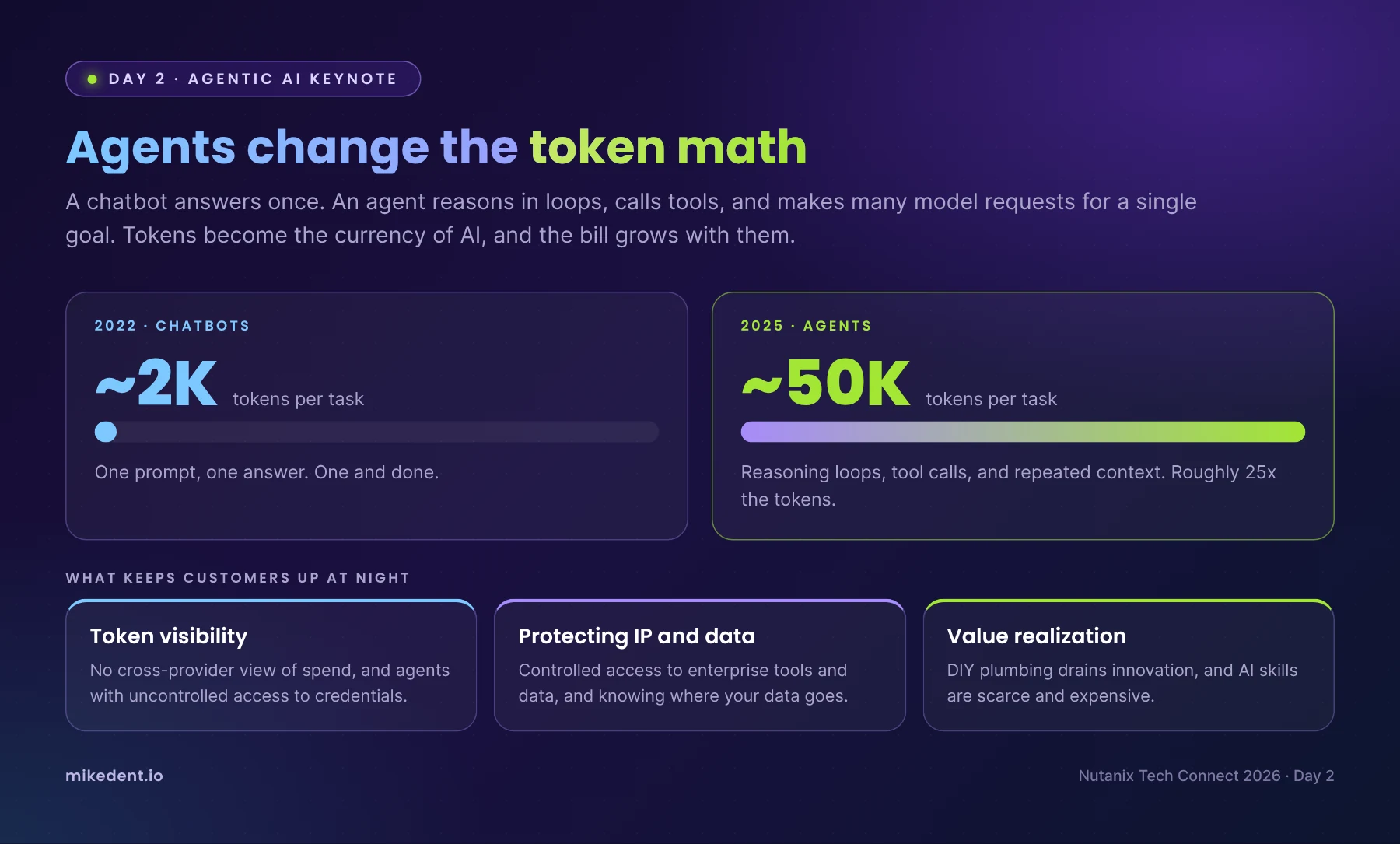
- Agents burn far more tokens. A 2022 style chatbot used roughly 2,000 tokens per task in a one and done exchange. A 2025 agent working in reasoning loops uses around 50,000. As tokens get cheaper, we just use more of them. (Sound familiar? Same thing happened with storage.)
- Frontier models will stay premium. The leading frontier providers are creating value and will keep pricing to capture it. Meanwhile, smaller and open models are pulling the average cost per token down. The winning strategy is a mix, with premium models for the hard reasoning and cheaper models for everything else.
- Open models are good enough for most work. Open weight models are cheaper and improving every quarter, and Anindo put them at good enough for 80 to 90% of use cases. Anyone consuming tokens at scale will need an open weight option in the mix.
- The challenges haven't changed. No visibility into token use across providers, agents with uncontrolled access to credentials, protecting IP and enterprise data, and the reality that DIY maintenance drains innovation while AI skills stay scarce.
- Agents need infrastructure and governance. Agents run on CPUs, the heavy lifting happens on GPUs, and most organizations will consume inference rather than train models. Agents can't be left to run around the playground unsupervised, so governance has to be part of the architecture from the start.
The second half of the keynote laid out the strategy. Most GPUs live with hyperscalers and the new wave of AI focused "neoclouds," and Nutanix wants to turn those AI factories, on-premises or not, into AI clouds that developers and agents can consume like a service.
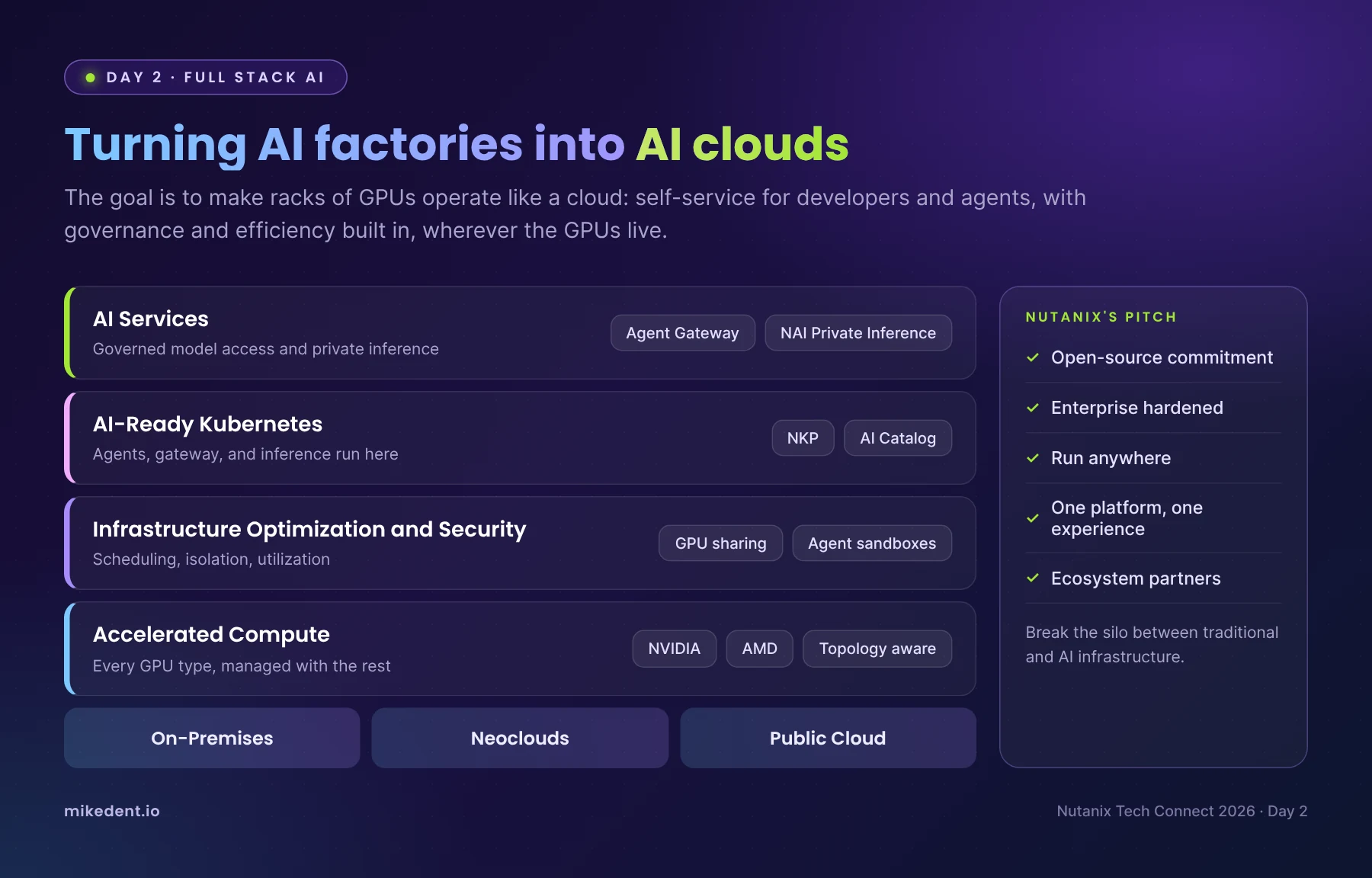
The stack runs bottom up, starting with accelerated compute that supports every GPU type, then infrastructure optimization and security (including a topology aware hypervisor), an AI ready Kubernetes platform in NKP, and an AI services catalog on top. The pitch for why Nutanix wins here came down to five points: open source commitment, enterprise hardening, run anywhere, one platform and one experience, and the ecosystem.
My take: The token math is the slide I'd tape to the fridge of every CIO building an AI budget. Most cost models I see are based on chatbot usage, and they will be wrong by an order of magnitude the moment agents show up. What I like most about the strategy is that Nutanix won't split "AI infrastructure" off from "regular infrastructure." We spent the last decade breaking down silos in the data center, and I'd hate to watch customers build a shiny new one for GPUs with its own team, tools, and security model.
Nutanix Enterprise AI: Private Inference Without the Science Project
Ganesh from the Nutanix Enterprise AI (NAI) team walked through private inference. The case for it rests on three questions customers keep asking:
- How do I keep my data and IP private? Open weight and fine-tuned models keep your data in your control.
- How do I control cost as usage scales? Inference optimizations keep costs predictable as token volume grows.
- How do I get started while I'm still waiting on GPU hardware? You don't have to start with an on-premises GPU farm. You can reserve GPU capacity in AWS or Azure, front it with NAI for management and budgeting, and move on-premises later.
NAI also runs in environments with no external network access, which matters for regulated and air gapped sites.
Why Predictable Beats Cheap
Public cloud and frontier model APIs are a fantastic way to start, but they get hard to forecast once agents are in the mix. Pricing is per token and it's set by the provider. They can change the price, rate limit you, throttle you, or charge more once you blow past a usage cap, and you find out when the bill shows up. At a few million tokens a month that's a rounding error. At hundreds of billions, it's a line item the CFO will ask about.
Private inference flips the model. Instead of paying per request, you buy the software and the GPU capacity, and your token cost becomes a fixed, plannable number. Run a validated open weight model on capacity you control, on-premises or reserved in the cloud, and every additional token is effectively already paid for. You can budget for that a year out instead of watching a meter nervously every month.
It doesn't have to be all or nothing, either. The Agent Gateway (more on that below) can route the bulk of everyday work to private, open weight models and send only the tasks that need it to a frontier model. Thomas mentioned on Day 1 that Nutanix already does this internally, using an AI gateway to steer its own engineers from frontier models back to on-premises models wherever the results hold up.
Controls Beyond the Endpoint
A model and an endpoint don't make an enterprise product. NAI adds the controls around them: usage visibility per API key, budgets and throttling, endpoint sizing and instance counts, a validated model catalog that Nutanix tests before publishing, and optimization recipes tuned for specific GPUs and workloads.
Security got plenty of airtime, which made the security nerd in me very happy. NAI integrates with Palo Alto Networks Prisma to scan a model before anyone builds an endpoint on it, and to run attack and stress tests against the endpoint itself.
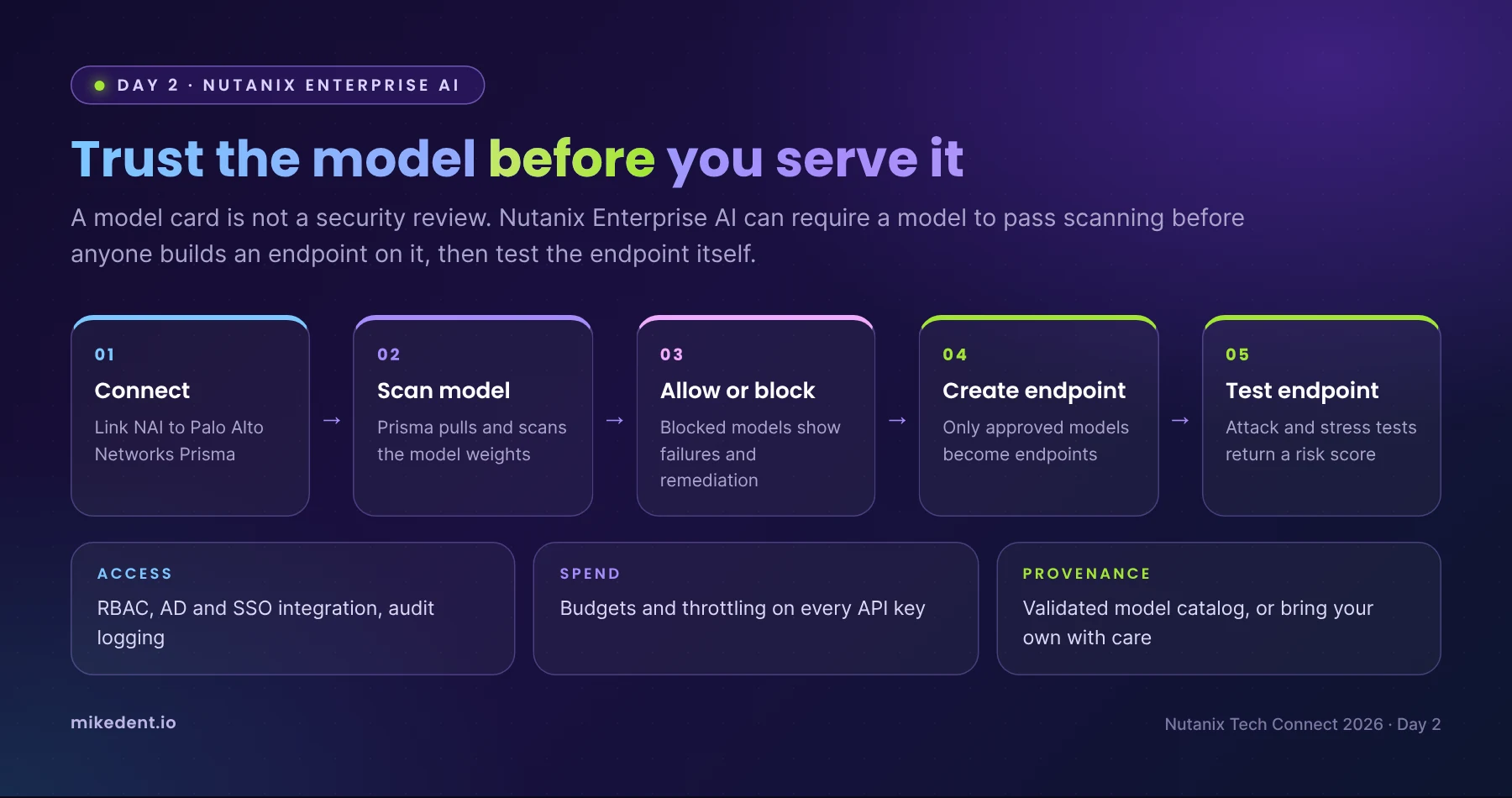
Ganesh pointed out that a model card and its disclosed risks are not a security review, and I agree with him completely. Models should be tested before they're qualified for use, and you should know the provenance of anything you upload. RBAC, AD and SSO integration, and audit logging round out the controls.
Optimizations That Pay for Themselves
This was the most technical part of the day and one of the most valuable. Grab a coffee. Agents send much of the same context over and over, and without optimization you pay to process the same tokens two, three, or ten times. That's like buying the same textbook every time you open it.
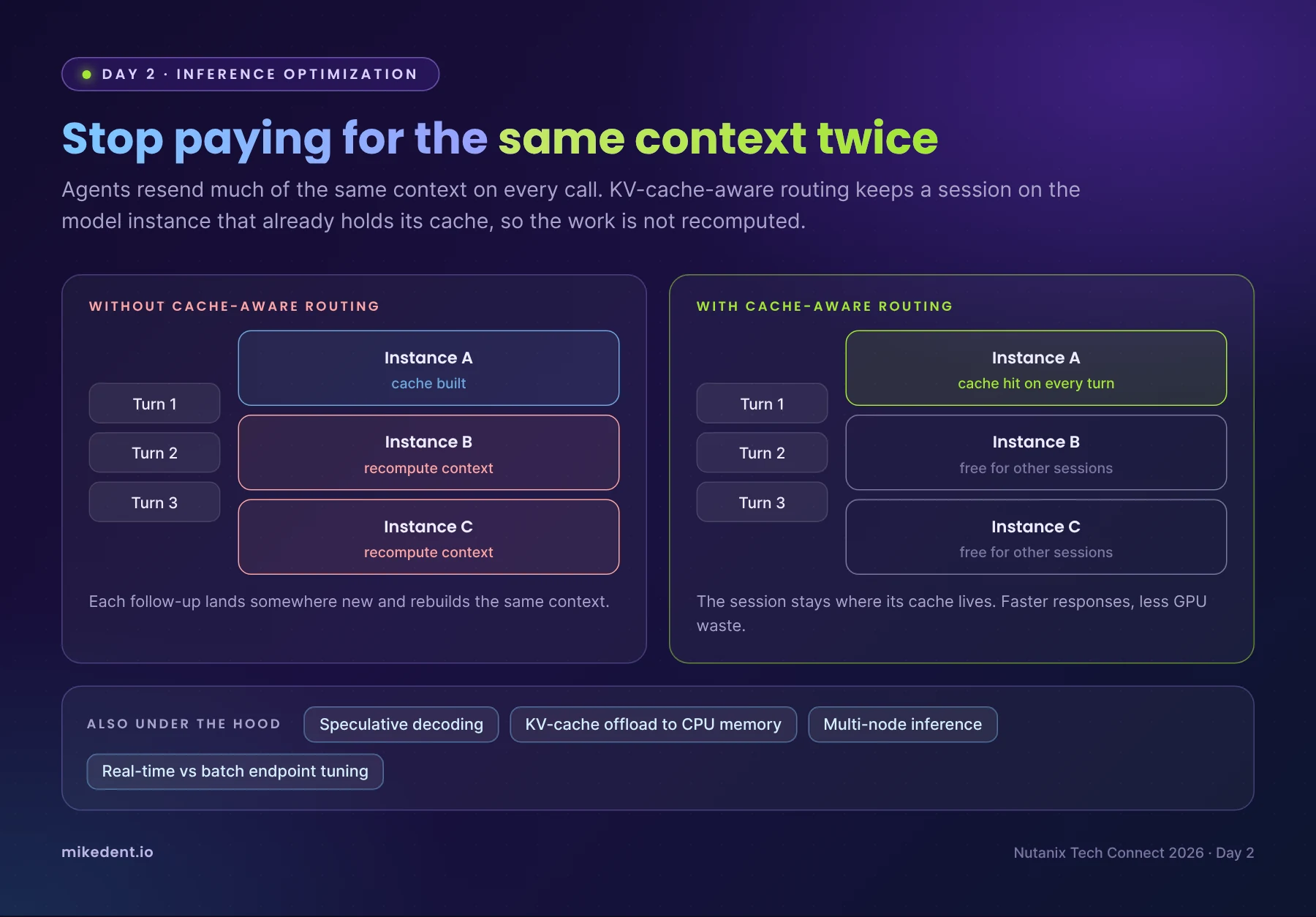
- KV-cache-aware routing. Follow-up requests in a session go to the model instance that already holds that session's cache, so the shared context isn't recomputed.
- Speculative decoding. A small draft model proposes several tokens that the main model checks in one pass, which speeds up generation after the first token.
- KV-cache offload. Extends cache capacity into CPU memory.
- Multi-node inference. Models no longer have to fit on a single node, which lets NAI host much larger models without heavy quantization.
- Workload tuning. Endpoints can be tuned for real-time or batch work, trading latency against throughput.
NAI also supports supervised fine-tuning with LoRA today, so you can teach a model your organization's terminology and spin up an endpoint for the result. Vector databases for RAG stay outside NAI by design. NAI hosts the embedding model endpoint, and you bring the vector database of your choice.
Some of the best input came from the room. One customer described the path to a first working deployment: find hardware, build a cluster, deploy Prism Central, install NKP, deploy NAI, then go register with Hugging Face and accept a license. That's a lot of homework before anyone sees value. Nutanix is working on it, with CPU-based small language models and a simpler "hello world" experience on the roadmap. For a lot of organizations, the first AI win doesn't need a GPU at all, and getting there in an afternoon would make adoption much easier.
Agent Gateway: A Governed Front Door
Justin, the Product Manager for the Agent Gateway, covered the piece I think will matter most to the customers I work with. It's also the clearest answer yet to the guardrails question Thomas raised on Day 1 about letting agents anywhere near production data. Nutanix is a maintainer of the open source Agent Router project, and the Agent Gateway is the enterprise ready layer on top of it, adding access control, auditability, a UI, and integration.
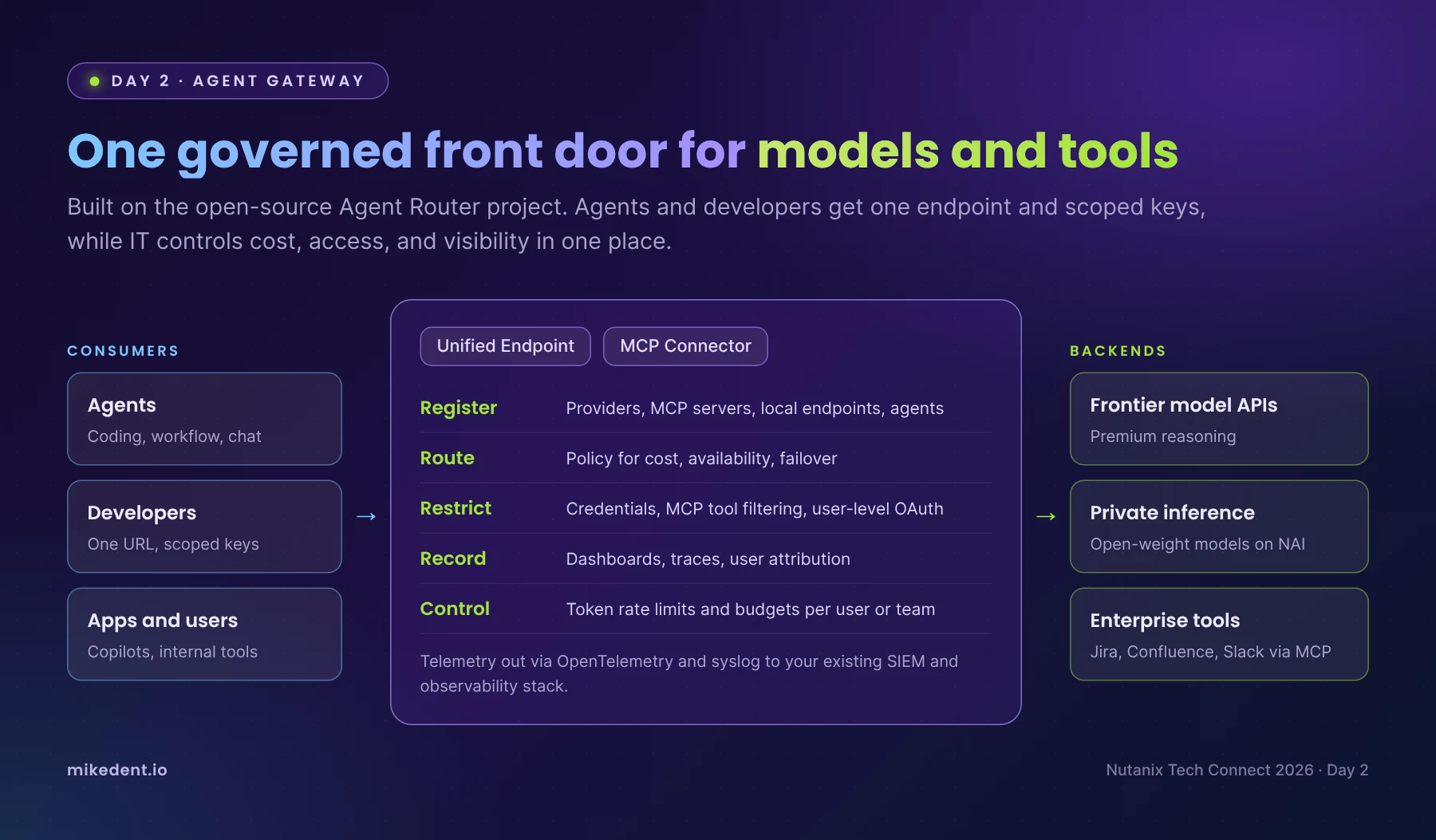
The gateway has two components: a unified endpoint that can combine local, private, fine-tuned, and external models behind one URL, and an MCP connector that brokers access to tools like Jira, Confluence, and Slack. Around that, the controls fall into five buckets:
- Register. Providers, MCP servers, and local endpoints, with an agent registry coming.
- Route. Central routing policy for cost and availability. If a frontier model is down or a team hits its budget, traffic fails over to another provider or a local model.
- Restrict. Credential management and MCP tool filtering, so a team that needs Slack gets only the Slack functions it needs, read-only if that's all it requires. OAuth-based MCP auth with user level permissions is on the way.
- Record. Dashboards, metrics, logs, and traces, exported over OpenTelemetry and syslog into the observability and SIEM tools you already run. The gateway records the transaction without inspecting the request body.
- Control. Token rate limits per user, team, or model, and least privilege access for self-hosted MCP servers.
The feature that got the most nods in the room was model aliasing. Developers can call a logical model like "large" or "small," and administrators can swap the model behind it for something cheaper or faster without touching application code. One attendee made the point that adoption lives or dies on not changing people's workflow. If a developer only has to change a server URL in their existing tools, the gateway is an easy sell.
I expect this one to have the fastest impact of anything we saw, because it solves a problem every organization already has. Right now, AI access in most companies looks like a junk drawer: personal credit cards, shared API keys, and shadow tools nobody approved. A gateway with scoped keys, team budgets, and a full audit trail turns that into something IT can govern.
The candid discussion about adoption barriers was refreshing, too. Several people in the room said their customers have been told to "go build an AI strategy" without a clear problem to solve. Those customers need simple, concrete use cases and a hands-on proof of concept to get moving.
Service Experience: Support Is Part of the Product
Rajendra and Anu from the Service Strategy and Enablement team made the case that the support experience gets designed in during product planning. Nutanix reported an NPS of 90. NPS runs from -100 to 100, and anything above 70 is generally considered world class. Holding 90 means nearly every customer who answers the survey would recommend Nutanix to a peer.
For any customer, support is who picks up the phone when a cluster is down at 2 AM. No matter how big the environment is or what runs on it, the person on the other end of that call matters more than any feature on the roadmap. A score like that is a big reason customers trust Nutanix with workloads that can't go down.
The most useful part of the session was the back and forth. Customers and partners in the room shared what's working, pushed hard on what isn't, and the team listened, answered, and took notes on what still needs work.
One Release Train, Staged Through LCM
The biggest operational change is the release model. Separate LTS and STS tracks are gone in favor of one cycle with feature, maintenance, and patch releases.
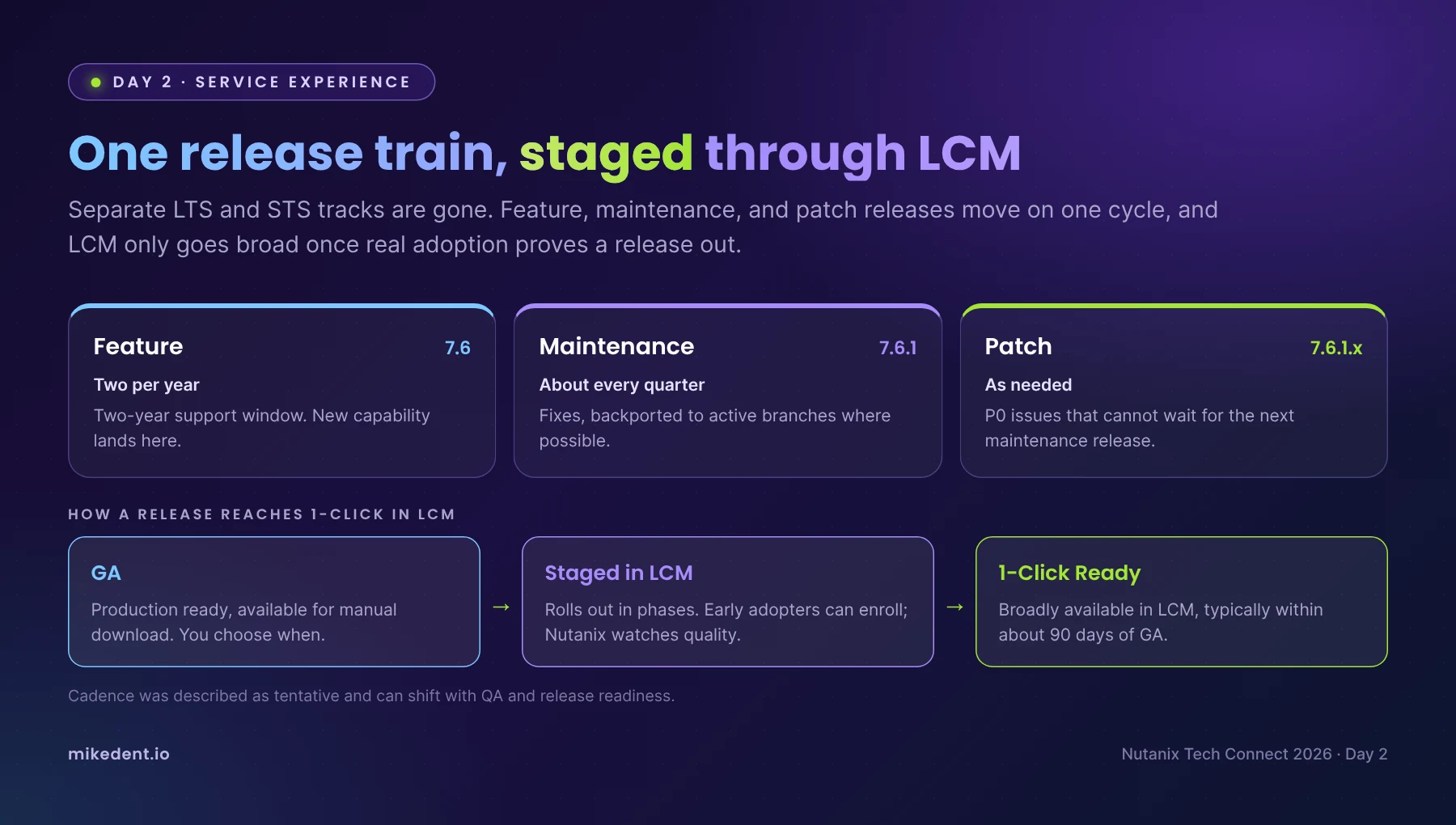
- Feature releases twice a year, each with a two-year support window (for example, 7.6).
- Maintenance releases about every quarter (7.6.1), with fixes backported to active branches where possible.
- Patch releases for P0 issues that can't wait (7.6.1.x).
- Staged LCM rollout. A GA release is available for manual download right away, then rolls out through LCM in phases while Nutanix watches adoption and quality. It typically becomes one-click ready within about 90 days of GA.
The cadence was described as tentative and can shift with QA results, but the direction is clear.
What Customers Pushed For
This group of customers and partners didn't hold back, and I appreciated that the team took it all head on:
- Faster, smaller security fixes. Security advisories have been frequent, and customers don't want a full AOS maintenance release to fix one small component across dozens of clusters. Nutanix is looking at containerization and modular fixes to make remediation easier to adopt.
- Faster LCM. Firmware inventory is slow because it has to query OEM tools. A quick software-only inventory as the default is part of the roadmap discussion, along with smarter batching to avoid extra reboots.
- SSH hardening without losing diagnostics. SSH hardening is coming to AOS and AHV, with a restricted mode that still allows approved diagnostic tools on the CVM. SRE input will help define the approved list.
- More KB content. Nutanix is steadily externalizing more internal KBs and has a team focused on KB freshness.
Support Tools to Know
- Nutanix Validated Designs. Tested starting points with documented architecture, sizing, and integrations. Start from your workload and availability requirements, pick the closest NVD, and customize from there.
- Insights Portal and Discoveries. A central view of assets, software and firmware currency, and aging hardware, with Discoveries using Pulse telemetry to flag risks and corrective actions before something breaks. One-click diagnostic collection sends log bundles straight to support.
- Neva. The Nutanix Intelligent Virtual Agent in the support portal answers plain language questions from vetted sources. Customers asked for Neva to use their own asset data, and the long term goal is to bring it into the product itself.
My take: Staged LCM releases are a win for every customer I support. Most of them never want to be the first kid in the pool on a new build, and now the platform enforces that patience for them. The security patching conversation was the most important one in the room, though. Advisory fatigue is real, and when a small fix requires a full maintenance release across 30 clusters, organizations delay remediation. Security teams want the exact opposite. I'll be watching the modular fix work closely.
The Customer Q&A
The day closed with an open Q&A with Nutanix leadership, and a few themes came up:
- The platform keeps opening up. This picked up where Thomas left off on Day 1. Leadership said broader external storage support has materially eased adoption over the past year, since customers can keep hardware they already own.
- NKP is the home for AI. The Kubernetes platform was described as three parts working together: the platform for running agents, the gateway, and the inference stack.
- Capacity is the AI bottleneck. Customers want to move in days, but GPUs, power, cooling, and data center space take months. The practical path for many is to start on neocloud or hyperscaler capacity and add on-premises capacity later, with Nutanix working to stand up the NKP AI stack quickly wherever the GPUs are.
My Key Takeaways
A week later, this is what I think Day 2 means for organizations.
- Budget for agents, not chatbots. A 25x jump in tokens per task changes the cost model. Plan for routing, budgets, and open weight models before the bill arrives.
- Governance is the on-ramp. The Agent Gateway is how IT says "yes" to AI safely. Scoped keys, tool filtering, and audit trails let teams experiment without handing agents the keys to everything.
- Predictable beats cheap. Cloud and frontier model APIs are a great place to start, but per-token pricing you don't control gets painful at agent scale. Private inference on-premises turns token spend into a fixed, plannable cost, with sovereignty and model security scanning as a bonus. And you can still start in the cloud while you wait on hardware.
- Start small and prove value. The best feedback of the day was about time to first win. A CPU-based model that works out of the box will get more AI projects off the ground than a perfect GPU design that takes six months.
- The unglamorous work still matters most. Staged releases, faster LCM, and smaller security fixes won't show up on an AI slide. They're still what make a platform trustworthy enough to bet your AI strategy on.
Wrapping Up Tech Connect 2026
Two days, a lot of whiteboard conversations, an empty lunchbox, and a notebook full of follow-ups. School's out. Looking back, what stood out most is how connected the story is. NKP is the foundation, Cloud Native AOS and NDK protect the data, NKP Insights secures the fleet, and NAI and the Agent Gateway put AI to work on top with guardrails in place.
By the end of Day 2, I'm pretty sure every NTC in the room was as mentally fried as I was. You could see it on our faces. But there's a different kind of tired that comes from two days of deep technical conversation, and it's the good kind. Everyone I talked to on the way out was energized and already thinking about how to take this back to their organizations and customers. That's my favorite part of Tech Connect. We all leave with more to give.
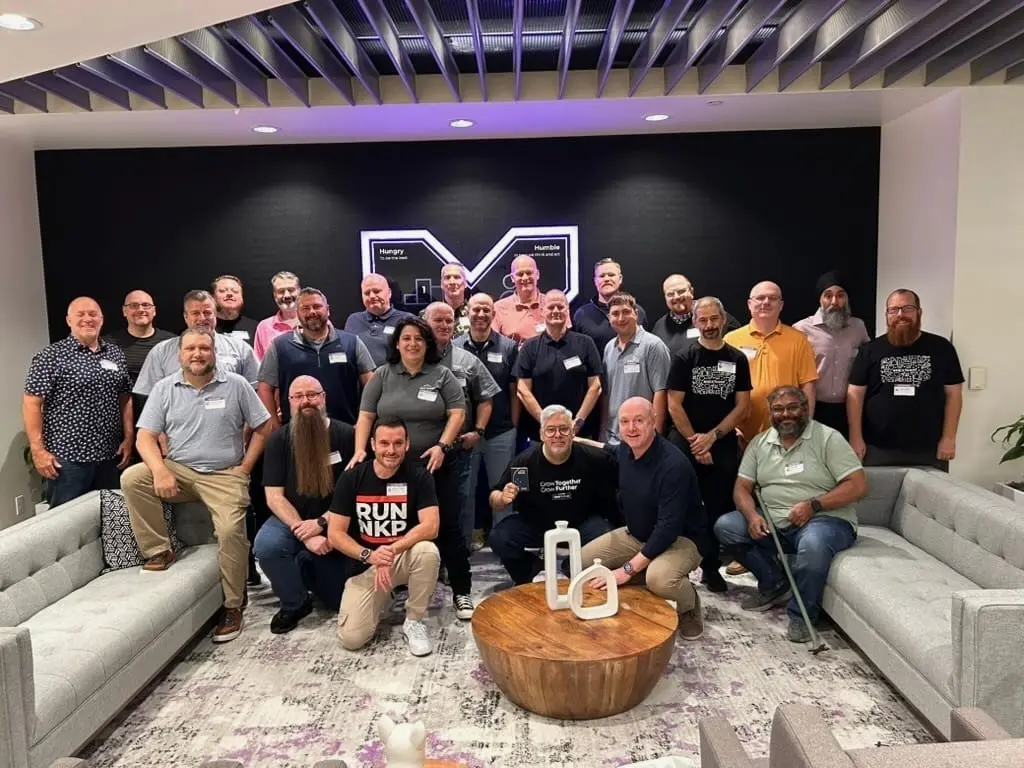
A big thank you to the NTC program team for the invite and to every PM and engineer who spent two days answering our hardest questions.
Where is your organization on the AI journey? Still defining the strategy, piloting with a few teams, or already fighting the token bill? I'd love to hear what's working, what's blocking you, and which of these capabilities you'd want to try first.
Connect with me on LinkedIn or reach out at mike@mikedent.io.